
Why do we brew coffee at 94°C? How water temperature really affects taste
"I've been setting my pour-over kettle to 94°C, this weekend I realised I didn't actually know why". Daniel
I know what happens when I change the grind, because I can watch a V60 draw down faster or slower. I understand what happens if I change the coffee-to-water ratio, pour more aggressively or let the bloom run longer.
94°C, though, had quietly become one of those numbers I used because it felt established. It sits in the range recommended by people whose coffee advice I trust, and it works, so at some point I stopped asking what it was actually doing.
So why 94°C? Why not 88°C, or boiling? Does hotter water really make coffee bitter, and do lighter roasts need hotter water? And if espresso can finish in half a minute while a cafetière takes several, why can both use water somewhere in the low to mid 90s? I went back to the research to find out.

The short answer: 94°C is a starting point, not a magic number
Water temperature matters because it changes the conditions coffee extracts under. Hotter water generally speeds up the rate at which soluble material moves from the grounds into the brew, and it can shift the balance of which compounds come out.
That much is fairly obvious, and it's also where a lot of coffee advice gets too simple. The usual shorthand says cooler water gives sour coffee and hotter water gives bitter coffee. There's a grain of practical truth in that if everything else in the recipe stays fixed, but the science points to a more useful way of thinking about it.
Temperature changes the extraction conditions, but what you actually taste is more closely tied to the strength and extraction you end up with.
The clearest evidence comes from a 2020 UC Davis study by Batali, Ristenpart and Guinard. They brewed drip coffee at 87°C, 90°C and 93°C, but rather than leaving the rest of the recipe alone, they adjusted grind size and brew time so every coffee reached the same brew strength and extraction yield.
Once those were matched, changing the brew temperature across that range had almost no appreciable effect on how the coffee tasted, while strength and extraction yield did. [1]
That idea runs through the rest of this article: neither 93°C nor 94°C has a flavour of its own. They're conditions that help a recipe reach a particular extraction.
What do "strength" and "extraction" actually mean?
In everyday coffee talk the two terms get used interchangeably, but they describe different things.
Brew strength is usually measured as total dissolved solids, or TDS. It describes how concentrated the drink in your cup is, so a higher TDS means more dissolved coffee relative to water.
Extraction yield is the proportion of the original dry coffee that has dissolved into the drink.
That means you can have a coffee that's fairly concentrated without being especially highly extracted, or one that's more dilute but has pulled a greater share out of the grounds.
The distinction matters because a large body of recent UC Davis work has found that flavour moves across this two-dimensional space in more complicated ways than the old labels of "under-extracted", "ideal" and "over-extracted" suggest.
In Frost, Ristenpart and Guinard's 2020 study, a washed Arabica was roasted light, medium and dark, then brewed at nine combinations of TDS and extraction yield for each roast. Of the 30 sensory attributes they evaluated, 21 changed significantly in at least part of the experiment, and burnt or ashy character, citrus, sourness, bitterness, sweetness, thickness and flavour persistence all responded significantly across all three roast levels. [2]
The team later combined those results with their temperature and consumer-preference work into a new Coffee Brewing Control Chart. Rather than marking out one small area as universally "ideal", it maps how sensory attributes change as strength and extraction move. [3]
For our temperature question, that gives a much more useful chain:
Water temperature → changes the extraction conditions → changes strength and/or extraction yield → changes the balance of the cup.

So what does hotter water actually do?
Brewing coffee is a solid-liquid extraction: water gets into the porous structure of the grounds, soluble compounds dissolve, and those compounds move out into the surrounding liquid. Temperature affects how quickly that happens, but not every compound responds in the same way.
An espresso study by Sánchez López and colleagues tracked aroma compounds in real time as shots ran at different water temperatures and pressures. Higher temperatures extracted the volatile compounds more efficiently, and some groups, particularly the non-polar compounds that dissolve less readily in water, responded more strongly than others. [4]
So "hotter water extracts more" is reasonable shorthand when you're comparing otherwise identical brews, but it needs a second half: hotter water changes how extraction proceeds, and grind, time, flow and ratio can move the final result just as much.
It's also why turning the kettle up isn't automatically the cure for every weak, sour or disappointing cup. If the grind is much too coarse, fixing that will usually do far more than adding a degree or two.
Why does everyone recommend something around 93°C?
The familiar number has a real basis. The Specialty Coffee Association's home brewer certification requires water in contact with the coffee to reach at least 92°C within the first minute and stay between 92°C and 96°C during brewing. [5]
Our own V60 brew guide starts at about 93°C, with 96°C to 98°C suggested for lighter roasts. [6]
James Hoffmann goes further in his widely watched video on brewing temperature, arguing for water at or near boiling for light roasts and bringing the temperature down as roasts get darker. He presents this as guidance rather than a rule, and he makes the useful point that kettle temperature isn't the same as the lower temperature the slurry actually reaches. [7]
That last point matters more than it sounds. With the kettle reading 94°C, the coffee bed isn't sitting at a steady 94°C, because heat is being lost to the spout, the air, the filter, the brewer, the grounds and the server, and the slurry temperature keeps changing throughout the brew. It's one reason preheating the V60 and rinsing the filter help, since cold equipment would otherwise soak up brewing heat straight away.
So my 94°C setting makes sense because it gives an open, gravity-fed brewer a reasonably energetic and repeatable starting point, not because anyone has identified it as the flavour optimum for my coffee.
Why a faster brew doesn't automatically need hotter water
This was the practical question I found most interesting. If heat speeds up extraction, you'd expect a very fast method to need much hotter water than a slow one, yet espresso, V60 and cafetière have radically different brew times and still sit in broadly similar temperature territory. The reason is that time is only one part of the extraction system.
Pour-over: hot water, medium grind, continuous flow
A V60 typically uses a medium grind, a few minutes of contact time and a continuous supply of fresh water moving through the coffee bed. It's also an open brewer that loses heat the whole time, so starting around 93°C to 95°C gives it enough thermal energy to extract efficiently while gravity, grind, pouring technique and drawdown do the rest.

If I dropped my kettle from 94°C to 85°C and changed nothing else, I'd be changing the extraction conditions substantially. That doesn't make good coffee impossible at 85°C, because I could compensate with a finer grind, a longer contact time or a different pouring pattern. It's effectively the lesson of the Batali study, where quite different temperatures reached very similar sensory results once the researchers compensated elsewhere in the recipe. [1]
Espresso: very little time, a lot of help elsewhere
A shot might only take 25 to 30 seconds, but it uses an extremely fine grind and pressurised water moving through a compact bed. The tiny particles give a huge surface area, and pressure pushes water through a bed that would barely drain under gravity, so temperature is only one of several powerful controls. That's why espresso doesn't need impossibly hot water just because it's fast.
Temperature does measurably change espresso aroma extraction, as the study above shows [4], but in practice it's one dial alongside grind, dose, yield, pressure and flow.
Cafetière: long contact, coarse grind
A cafetière takes far longer than espresso, but the coffee is normally ground much more coarsely. The coarse grind gives less surface area, several minutes of immersion make up for it with time, and the brew cools steadily throughout. That's why a cafetière can comfortably start in the same low to mid 90s as a pour-over, and why a long brew time doesn't automatically mean a low brewing temperature.
AeroPress: trading one variable for another
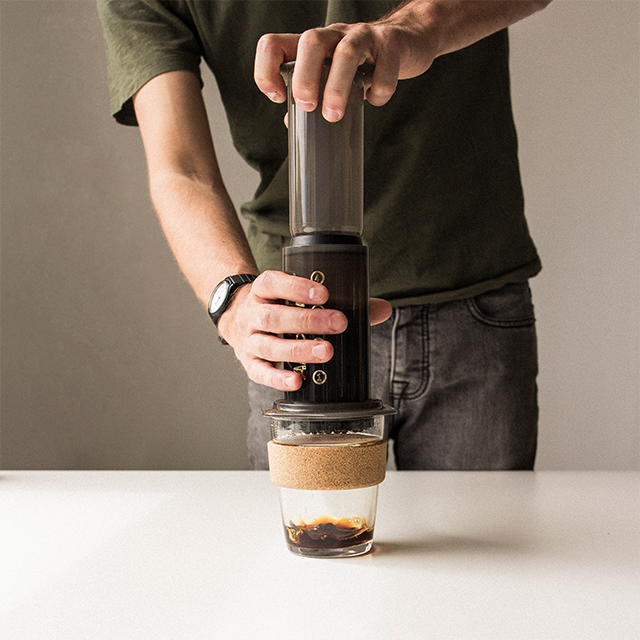
AeroPress makes the relationship especially obvious, because successful recipes exist across a very wide spread of temperatures, grind sizes and steep times. You can use cooler water and compensate with longer contact, a finer grind or more agitation, or use hotter water and build the rest of the recipe differently. The brewer isn't exempt from extraction physics, it just gives you enough flexibility to move several variables independently.
Cold brew: remove the heat, add hours
Cold brew is the extreme case. A 2024 UC Davis study compared full-immersion coffee brewed at 4°C, 22°C and 92°C over time. Roast level had the largest overall influence on sensory profile, brewing temperature also had significant effects, and some long cold or room-temperature brews moved towards profiles seen in much shorter hot brews. [8]
Cold and hot brew aren't chemically identical, but the practical principle holds: take away a lot of thermal energy and you can partly make up for it with a lot of time.

Light roast hotter, dark roast cooler: useful advice, not a law
This is one of the most common temperature rules in speciality coffee, and there's practical sense behind it, since roasting changes coffee physically and chemically and darker roasts produce a very different sensory landscape from lighter ones.
The Frost roast study is a good reminder not to reduce it to a temperature table, though. Roast level, strength and extraction all interacted, and many attributes changed across that combined space. [2] The later immersion study found roast level had an even bigger influence on the overall sensory profile than brewing temperature under its test conditions. [8]
So I'd treat roast as a clue about where to begin. With a lighter coffee, hotter water can help you reach the extraction and flavour you want without forcing a very fine grind or a long brew. With a darker coffee, backing off the temperature can stop roast-derived bitterness or harshness going further than you enjoy. If the coffee already tastes balanced, the roast colour doesn't oblige you to touch the kettle.
What that means with coffees we actually roast
Rather than talk about theoretical light and dark coffees, here are a few from our current range.
Indonesia Gayo Natural: a good 94°C test coffee
Our Indonesia Gayo Natural is roasted medium-light, with bergamot and citrus on top, pineapple and lime through the middle and a nutty finish. We keep the roast restrained to hold on to that brighter fruit and citrus character. [9]
For a V60 I'd happily start anywhere from 93°C to 95°C, and 94°C is exactly where I'd begin. If the cup is sweet, defined and balanced I'd leave the temperature alone. If it tastes hollow and sharp after I've checked grind and brew time, a slightly hotter brew is worth testing, and if it turns drying or the finish gets harsher than I want, I might go cooler. The point is that I'm changing temperature in response to the cup, not because 94°C is right and 95°C is wrong.
The Italian: a darker contrast
The Italian is deliberately much darker, built around dark chocolate and toasted hazelnut with a bold, smoky edge. [10] If it tastes how you want it at 94°C, keep brewing it there, but if the cup is more roasty or bitter than you enjoy, dropping into the low 90s is a sensible experiment and fits Hoffmann's advice to bring the temperature down as roasts get darker. [7]
Kenya Orange Co-Ferment: temperature as a fine adjustment
Our Kenya Orange Co-Ferment is sweet and orange-led, with caramel, dark chocolate and pecan and a heavy, velvety body. In our write-up on the Lot 20 co-ferment we suggest grinding a little coarser or lowering the brew temperature slightly if the cup tastes too heavy or fermented. [11] That's the job I think temperature does best, as a fine adjustment once the basic recipe is already close.
What about acidity? Cooler doesn't simply mean "more acidic"
This is another place where the standard explanation gets muddled, because a sour cup doesn't simply mean cooler water extracted "the acids first". Coffee acidity is more complicated than that, both chemically and on the palate.
In a 2021 UC Davis study, researchers compared perceived sourness with both pH and titratable acidity across different roast levels, brew temperatures, strengths and extraction yields. Sourness correlated only weakly with pH but strongly with titratable acidity, and titratable acidity was itself closely correlated with TDS across the conditions tested. [12]
The difference matters because pH measures hydrogen ion activity, while titratable acidity reflects how much base it takes to neutralise the acids present. They're related measurements, but they aren't interchangeable.
At home the takeaway is simpler: sourness is an outcome of the whole brew, not a thermometer reading. If your V60 tastes sharply sour, the fix might be a finer grind, more contact time, hotter water, a different ratio or different water, or it might simply be a coffee with a high-acidity profile. Temperature is one possible lever, not the definition of acidity.
"Sweetness" is more complicated than it sounds too
The new Coffee Brewing Control Chart includes a region associated with perceived sweetness, but the researchers are careful about what that means, because brewed coffee contains relatively little simple sugar at concentrations we'd normally recognise as sweet. [3]
When we call a coffee sweet, the perception can come from aroma, lower bitterness, lower sourness and associations with flavours our brains link to sweet foods. That's useful to know when dialling in, because you aren't really trying to "extract the sugar", you're looking for a balance that reads as sweet.
Water temperature is only half the temperature story
There's a completely separate question: what temperature is the coffee when you drink it? Brewing temperature changes the extraction, while serving temperature changes how the finished coffee presents itself to your senses.
A 2017 study by Steen and colleagues evaluated the same Bourbon Caturra coffee at serving temperatures from 31°C to 62°C. Volatile release increased above 40°C, with several Maillard-derived aroma compounds rising particularly strongly above 50°C. Coffees between 50°C and 62°C were associated more with overall flavour intensity, roast and bitterness, while those between 31°C and 44°C were more associated with attributes including sourness and sweetness. [13]
Another study by Chapko and Seo compared Ethiopian, Kenyan and Colombian coffees at 70°C, 55°C, 40°C and 25°C, and found serving temperature accounted for considerably more of the variation in their sensory data than which coffee was in the cup. [14]
None of this means every coffee is better cold, only that the balance shifts as the cup cools. It's why an expressive speciality coffee can seem closed or roast-heavy when very hot, then open up into clearer fruit, acidity and sweetness a few minutes later.
Try it with Bette Buna Cherry Spark
Our current Bette Buna Cherry Spark has grapefruit and tonic water up top, with liquorice, cacao nib, dark cherry and chocolate underneath. [15]
Brew it once and taste it hot, but don't finish it. Come back five minutes later, then again once it's noticeably cooler. You aren't changing extraction any more, since that finished when you took the brewer away, only the temperature at which your nose and palate meet the same brew.
A separate UC Davis consumer study of black coffee between 56°C and 71°C also found that temperature affected how much people liked it, with the broadest acceptance around 58°C to 66°C in that group, though the authors were careful not to treat that as a universal optimum. [16]

The water itself can change the result too
If we're being honest about temperature, there's one more complication, which is that the water in the kettle isn't chemically neutral.
One of the most influential papers on brewing water is Hendon, Colonna-Dashwood and Colonna-Dashwood's 2014 study, which used computational chemistry to model how dissolved calcium, magnesium and sodium ions might interact with coffee compounds. It helped popularise the idea that mineral content can change extraction. [17]
More recent experimental work adds some nuance. In 2024, Bratthäll, Figueira and Nording added magnesium and calcium salts before and after brewing, then measured several organic acids directly. At concentrations typical of drinking water the effect on acid content was small, and adding the salts before or after brewing gave similar results. The authors concluded that extraction of those acids largely proceeds independently of the water's composition, with some flavour effects possibly happening after brewing instead. [18]
A 2025 filter-brewing study took a different angle, pairing a light and a dark roasted coffee with different waters. It found the coffee and the water together shaped the taste of the brew, with water hardness possibly affecting how taste compounds are released from the grounds. [19]
Minerals clearly matter, but "more magnesium extracts more fruit" is too simple to treat as settled science. For the 94°C question, it also means two people can copy the same kettle temperature, grind setting and recipe and still get different cups because their water is different.
So what should you actually change at home?
If you already make good pour-over at 94°C, I wouldn't start with the kettle. Keep the temperature fixed while you dial in grind size, which usually gives the clearest feedback, then use temperature as a deliberate second control. Our guide to getting the best out of your beans covers the basics of dialling in.
If it tastes thin, hollow or sharply sour
Try a slightly finer grind first if the drawdown allows it, since you may simply need more extraction. If grind and brew time are already sensible, raise the water temperature by a couple of degrees and compare. For my 94°C V60, that might mean testing 96°C rather than rebuilding the whole recipe.
If it tastes harsh, bitter or drying
Check whether the grind is too fine or the drawdown too long. If the recipe otherwise behaves well, dropping the temperature slightly is a legitimate way to change the extraction, especially with a darker coffee, so 94°C might become 91°C or 92°C.
If it tastes balanced
If it's balanced, leave it alone, even though a temperature-controlled kettle makes it tempting to fiddle. A recipe at 93°C isn't more correct than yours at 94°C, and a respected brewer using boiling water doesn't make your lower setting wrong. What you're judging is the cup, not the number on the kettle.
A useful experiment: 88°C, 94°C and 98°C
If you want to understand temperature rather than just read about it, this is the experiment I'd run. Take a coffee you know well. Indonesia Gayo Natural is a particularly good candidate, because its bergamot, citrus, pineapple and nutty character give you several things to look for. [9]
- Brew one V60 at 88°C.
- Brew one at 94°C.
- Brew one at 98°C.
- Keep the dose, grind, water, ratio and pouring pattern as consistent as you can.
- Note the drawdown time for each brew.
- Let the coffees reach roughly the same drinking temperature before comparing them.
Look for differences in sharpness, sweetness, bitterness, dryness, fruit definition, body and finish.
For the more interesting version, repeat it but let yourself change the grind on the 88°C and 98°C brews until their strength and flavour move closer to the 94°C cup. That gets much closer to the question Batali and colleagues were asking: are you tasting the temperature itself, or the extraction your temperature created?
So, why am I still brewing at 94°C?
Because it works, and that answer feels a lot less lazy now than it did at the start. 94°C sits comfortably inside the established hot-brewing range and gives my V60 plenty of thermal energy in an open brewer that loses heat the whole way through. It suits the grind, flow and contact time I normally use, and most importantly the coffee tastes good.
What I'd no longer say is that 94°C is the correct temperature for pour-over. With a particularly light coffee I've got a reason to test hotter, and with something darker where the roast feels too dominant I've got a reason to go cooler. If I make a big temperature change I know grind and time may need to move with it, and if I change the water I know the same recipe may not taste the same. The science makes brewing less precise and a lot more interesting.
Water temperature matters, but as part of a system that also includes grind, time, flow, agitation, ratio, roast and water chemistry. Once the coffee's brewed, its drinking temperature changes how it presents all over again.
So the kettle stays at 94°C tomorrow morning, and now at least I know why.

Indonesia Gayo Natural
Bergamot | Citrus | Pineapple | Nutty
Shop Gayo Natural
The Italian
Dark Chocolate | Hazelnut | Smoky
Shop The Italian
Kenya Orange Co-Ferment
Caramel | Dark Chocolate | Orange | Pecan
Shop the Co-Ferment
Bette Buna Cherry Spark
Grapefruit | Liquorice | Cacao Nibs
Shop Cherry SparkReferences and further reading
Numbered in the order they're cited in the article.
- Batali, M. E., Ristenpart, W. D. & Guinard, J.-X. (2020). Brew temperature, at fixed brew strength and extraction, has little impact on the sensory profile of drip brew coffee. Scientific Reports, 10, 16450. https://doi.org/10.1038/s41598-020-73341-4
- Frost, S. C., Ristenpart, W. D. & Guinard, J.-X. (2020). Effects of brew strength, brew yield, and roast on the sensory quality of drip brewed coffee. Journal of Food Science, 85(8), 2530-2543. https://doi.org/10.1111/1750-3841.15326
- Guinard, J.-X., Frost, S., Batali, M., Cotter, A., Lim, L. X. & Ristenpart, W. D. (2023). A new Coffee Brewing Control Chart relating sensory properties and consumer liking to brew strength, extraction yield, and brew ratio. Journal of Food Science, 88(5), 2168-2177. https://doi.org/10.1111/1750-3841.16531
- Sánchez López, J. A., Wellinger, M., Gloess, A. N., Zimmermann, R. & Yeretzian, C. (2016). Extraction kinetics of coffee aroma compounds using a semi-automatic machine: On-line analysis by PTR-ToF-MS. International Journal of Mass Spectrometry, 401, 22-30. https://doi.org/10.1016/j.ijms.2016.02.015
- Specialty Coffee Association. Certified Home Brewer Program Requirements. Water temperature requirements include 92°C to 96°C during brewing. SCA programme requirements
- York Coffee Emporium. How to Brew V60 Coffee. Read our V60 guide
- Hoffmann, J. Brew your coffee with boiling water: coffee brewing temperatures explained. Watch James Hoffmann's brewing temperature guide
- Liang, J., Batali, M. E., Routt, C., Ristenpart, W. D. & Guinard, J.-X. (2024). Sensory analysis of the flavor profile of full immersion hot, room temperature, and cold brewed coffee over time. Scientific Reports, 14, 19298. https://doi.org/10.1038/s41598-024-69867-6
- York Coffee Emporium. Indonesia Gayo Natural. View Indonesia Gayo Natural
- York Coffee Emporium. The Italian. View The Italian
- York Coffee Emporium. Kenya Lot 20: an orange co-ferment and the story of the Ava mould. Read the Kenya Lot 20 article
- Batali, M. E., Cotter, A. R., Frost, S. C., Ristenpart, W. D. & Guinard, J.-X. (2021). Titratable acidity, perceived sourness, and liking of acidity in drip brewed coffee. ACS Food Science & Technology, 1(4), 559-569. https://doi.org/10.1021/acsfoodscitech.0c00078
- Steen, I., Waehrens, S. S., Petersen, M. A., Münchow, M. & Bredie, W. L. P. (2017). Influence of serving temperature on flavour perception and release of Bourbon Caturra coffee. Food Chemistry, 219, 61-68. https://doi.org/10.1016/j.foodchem.2016.09.113
- Chapko, M. J. & Seo, H.-S. (2019). Characterizing product temperature-dependent sensory perception of brewed coffee beverages: Descriptive sensory analysis. Food Research International, 121, 612-621. https://doi.org/10.1016/j.foodres.2018.12.026
- York Coffee Emporium. Roasters Reserve: Bette Buna Cherry Spark, Ethiopia. View Bette Buna Cherry Spark
- Ristenpart, W. D., Cotter, A. R. & Guinard, J.-X. (2022). Impact of beverage temperature on consumer preferences for black coffee. Scientific Reports, 12, 20621. https://doi.org/10.1038/s41598-022-23904-4
- Hendon, C. H., Colonna-Dashwood, L. & Colonna-Dashwood, M. (2014). The role of dissolved cations in coffee extraction. Journal of Agricultural and Food Chemistry, 62(21), 4947-4950. https://doi.org/10.1021/jf501687c
- Bratthäll, T., Figueira, J. & Nording, M. L. (2024). Influence of divalent cations on the extraction of organic acids in coffee determined by GC-MS and NMR. Heliyon, 10(5), e26625. https://doi.org/10.1016/j.heliyon.2024.e26625
- Liu, Y., Lin, J., Hu, S., Wang, G., Yang, C., Zhang, Z., Ren, D., Yi, L. & Li, S. (2025). Exploring the impacts and mechanisms of water on the taste extractions and perceptions of coffee brews: A case study in filter brewing. Journal of Food Composition and Analysis, 146, 107987. https://doi.org/10.1016/j.jfca.2025.107987
Further reading
- Barista Hustle. Solubility and brewing temperature. Technical background on how temperature changes dissolution and the solubility of different coffee compounds. Read the Barista Hustle lesson