

Article: How to make matcha at home: a step-by-step guide
How to make matcha at home: a step-by-step guide
Skip the life story and get the recipe ↓
I was just a young man when matcha first came into my life. I remember it clearly [narrates in Morgan Freeman]. A young woman had whisked me to the foot of Mt. Fuji…
I joke. Here's some interesting stuff I found about matcha:
Matcha has gone from tea-ceremony staple to café menu regular in a few short years, and plenty of people who order an iced matcha latte every week have never made one at home, which is a shame, because it's easier than it looks: good powder, water that isn't boiling, a bamboo whisk and about two minutes.
This guide covers what matcha actually is, what the research does and doesn't say about its health benefits, and the step-by-step method we use, so your first bowl comes out smooth and frothy rather than clumpy and bitter.
What is matcha?
Matcha is powdered green tea, made from the same plant as every other tea, Camellia sinensis, but grown and processed in a very particular way. For a period before harvest the tea bushes are shaded from direct sunlight, and with less light the leaves build up more chlorophyll and hold on to more of the amino acid L-theanine. That's where matcha gets its vivid green colour and its smooth, savoury sweetness, as set out in this review of matcha's chemistry.
After picking, the leaves are steamed and dried, and the stems and veins are removed. The flat leaf that's left is called tencha, and it's ground slowly into a powder fine enough to whisk straight into water.
The powder is what sets matcha apart from the green tea you'd brew in a pot. With loose leaf you steep the leaves and throw them away, but with matcha you whisk the whole leaf into the water and drink all of it, so you get more of everything the leaf contains, flavour and caffeine included.
You'll see matcha sold as ceremonial or culinary grade. Neither term is regulated, but broadly, ceremonial grade is made from younger leaves and is meant to be whisked with water and drunk, while culinary grade is more robust and bitter and better suited to baking and smoothies. For drinking, start with ceremonial.
Why drink matcha?
Most people come to matcha for the taste or for the kind of lift it gives, and some for the health claims. It's worth being straight about those, because matcha gets marketed as a superfood and the evidence is more modest than a lot of packaging suggests.
Caffeine with a calmer edge
Matcha contains a fair amount of caffeine. Lab measurements gathered in the 2020 Molecules review put it at roughly 19 to 44mg per gram of powder, depending on the leaf and the harvest, so a 2g serving lands somewhere around 40 to 90mg. For comparison, the NHS estimates about 75mg in a cup of tea and 100mg in a cup of instant coffee.
What makes matcha feel different for a lot of people is the L-theanine that arrives with the caffeine. In a placebo-controlled trial, 97mg of L-theanine taken with 40mg of caffeine improved performance on an attention-switching task, and the Molecules review notes that the pairing may help concentration more than either does alone. Studies use measured doses that don't map neatly onto a bowl of matcha, so we'd treat this as a plausible reason for the calm focus people describe rather than a promise.
Antioxidants
Green tea is rich in catechins, a family of polyphenol antioxidants, and the most studied of them is EGCG. Because you drink the whole leaf, matcha is a concentrated source, and the same review records high levels of rutin, vitamin C and chlorophyll compared with other green teas.
What the research doesn't say
Much of the exciting-sounding work on matcha and EGCG, around metabolism, inflammation and the brain, comes from cell and animal studies or from green tea extracts at doses well beyond a daily drink. The authors of the review conclude that randomised trials in people are still needed before firm claims can be made. Our view is that matcha is a good drink that sits well in a healthy routine, rather than a medicine.
Mind the caffeine
Matcha has real caffeine, so count it alongside your coffee and tea. If you're pregnant, the NHS advises no more than 200mg of caffeine a day from all sources. If you're cutting back in general, our guide to half caff coffee is worth a read.
What you'll need
- Matcha: 2g per bowl, ceremonial grade for drinking
- A bamboo whisk (chasen): its fine tines do what a spoon or fork can't
- A wide bowl: gives you room to whisk without splashing
- A 2g measuring spoon: saves weighing every time
- A whisk stand: keeps the whisk in shape between uses
- A kettle, and a fine tea strainer if you want to sift
Everything apart from the kettle and strainer comes in our Matcha Starter Set.
How to make matcha, step by step
This is usucha, or thin tea, the everyday style. It makes a small, frothy bowl that you sip straight from the bowl. Our measures follow the standard usucha ratio used by Kyoto tea house Ippodo: 2g of matcha to around 60ml of water at 80°C.


-
1
Soak the whisk and warm the bowl
Stand the whisk, tines down, in a little warm water in the bowl for a minute. Dry bamboo tines are brittle, and soaking softens them so they're less likely to snap. Tip the water out and dry the bowl, which will be nicely warmed by now.
-
2
Measure 2g of matcha
That's one level scoop of the 2g spoon in our set. Use a little less for a lighter bowl, but we wouldn't go much above 2g for usucha.
-
3
Get rid of the clumps
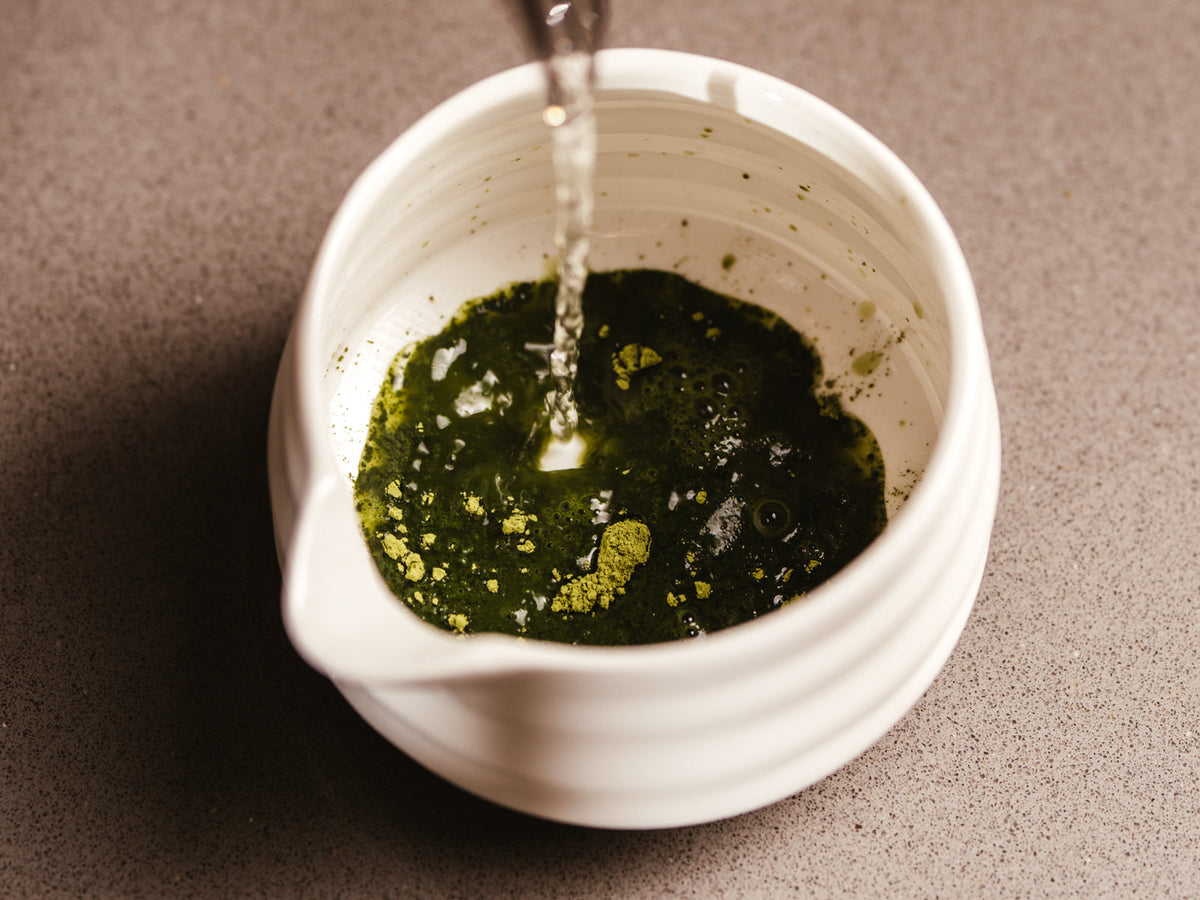
Matcha is so fine that it clumps with the slightest moisture. The traditional fix is to sift it through a fine tea strainer into the bowl. If you don't have one, add just a splash of water, around 15ml, and work it into a smooth paste with the whisk before adding the rest.
-
4
Add water at 70 to 80°C
Pour in about 60ml of hot water. Boiling water scorches matcha and pulls out bitterness, so if your kettle doesn't have a temperature setting, leave it to stand for a few minutes after it boils, or pour a splash of cold water into the bowl first.
-
5
Whisk
Hold the bowl steady with one hand and the whisk upright with the other. Whisk quickly from the wrist in a zigzag, an M or W shape rather than circles, with the tines just clear of the bottom of the bowl. Keep going for 15 to 20 seconds until the surface is covered in a fine, even foam, then slow down, skim the whisk lightly across the top to break any bigger bubbles, and lift it out from the centre.
-
6
Drink it straight away
Matcha starts to settle within a couple of minutes, so drink it while the foam is fresh. If you find a little sediment towards the end, give the bowl a swirl.
How to make a matcha latte
Make the matcha exactly as above, using about 50ml of water so the base is slightly stronger. For a hot latte, pour it into around 200ml of steamed milk. For an iced latte, fill a glass with ice and cold milk and pour the whisked matcha over the top for that layered look. Oat milk works particularly well, and you won't need sweetener unless you like it that way.

Common problems
- Bitter: the water was too hot or you used too much powder. Let the kettle cool and stick to 2g.
- Lumpy: the powder wasn't sifted or made into a paste first.
- Little or no foam: you're whisking in circles or from the arm. Keep it quick, from the wrist, in a zigzag.
- Dull, brownish colour: the matcha has been open too long or stored somewhere warm or bright.
Looking after your whisk and your matcha
Rinse the whisk in warm water straight after use, without soap, shake it out and leave it to dry on the stand. The stand holds the tines in their curved shape and lets air reach them, so the whisk lasts far longer than one left lying on its side, where the tines flatten and stay damp.
Matcha loses colour and flavour once it's opened, so reseal the pouch, keep it somewhere cool, dry and dark, and use it within about six weeks of opening.
Our matcha
Our Classic Ceremonial Matcha is the easy-going sort: clean and smooth with a gentle sweetness, a little umami depth and a mineral lift on the finish, without the grassy bitterness that puts some people off. It's lovely whisked with water and just as good in a latte. A 100g pouch makes around 50 bowls, and you can have it delivered fortnightly or monthly so you don't run out.
Once you've got the hang of it, a bowl of matcha takes less time than a pour over, and it's a nice thing to have in the rotation for the afternoons when another coffee feels like one too many.
Email subscribers hear about new releases first. Join the Dispatch for early access and offers.