
Article: What is 'Half Caff' Coffee
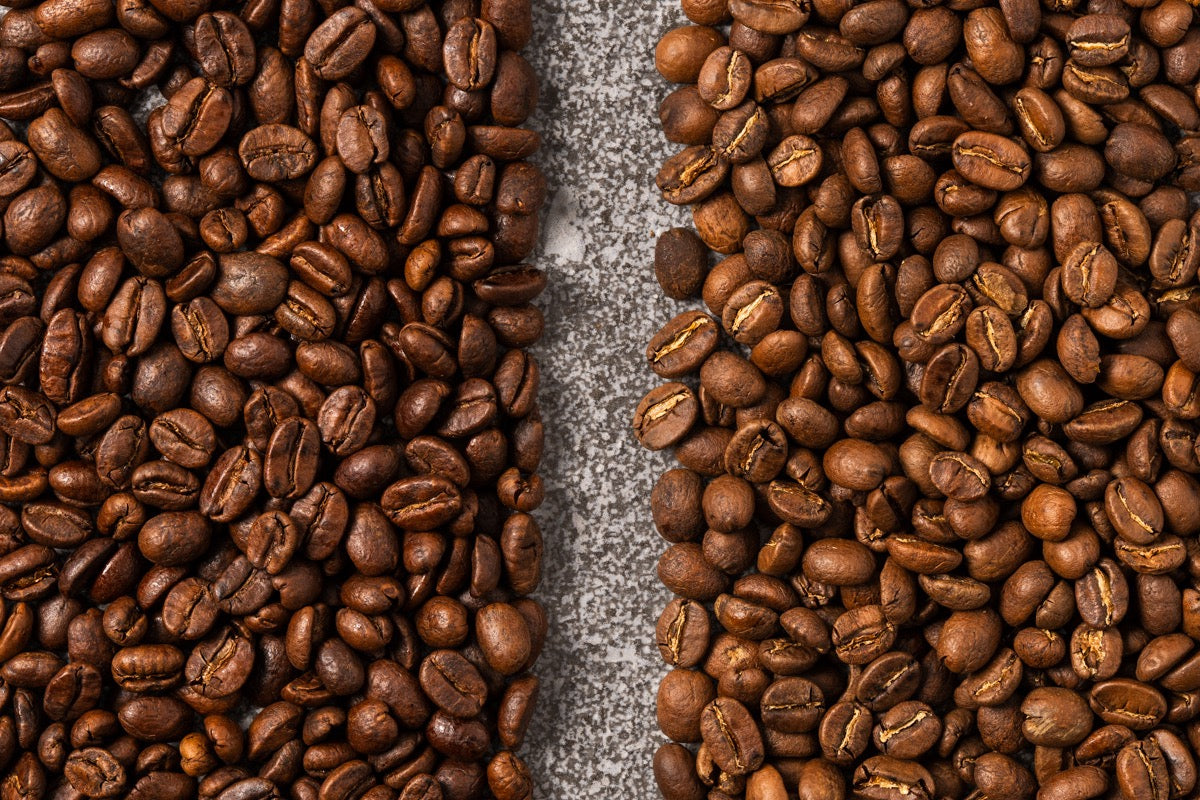
What is 'Half Caff' Coffee
Some people drink coffee to wake up. Some drink it because a good Kenyan tastes like grapefruit and caramel and they'd have it at midnight if they could get away with it. Most of us are somewhere in between, and the balance shifts through the day: the first one is a job, the third one is a pleasure.
Either way, there's a ceiling. Caffeine works, right up until the point it stops working and starts costing you instead. The jitters, the 3pm slump, the staring at the ceiling at half eleven wondering why. Most people hit that ceiling well before they've finished wanting coffee.
Half-caff is what happens when you move the ceiling.
What is half-caff coffee?
Half-caff coffee is a blend of caffeinated and decaffeinated beans, usually an even 50/50 split, giving you full coffee flavour with roughly half the caffeine of a normal cup. Not decaf. Not a compromise on taste. The same coffee with the dial turned down.
It sounds almost too simple to need explaining, and that's rather the point. No clever processing, no obscure varietal, no new technology. Two coffees, blended. What matters is which two, and how carefully they were chosen, which is where a lot of half-caff on the market quietly falls down. More on that below.
You'll see it written as half caff, half caf and half-caff. All the same thing. In cafés you might hear it called a "split shot".

How much caffeine is actually in it?
Here's where half-caff sits against everything else you might drink in a day. The figures come from the NHS and the US Food and Drug Administration, with the half-caff and decaf rows worked out from them.
| Drink | Approximate caffeine |
|---|---|
| Instant coffee, one cup | 100mg |
| Filter or coffee shop coffee | 100mg or more |
| Tea, one cup (black or green) | 75mg |
| Half-caff coffee, one cup | around 45 to 60mg |
| Energy drink, 250ml can | 80mg |
| Cola, one can | 40mg |
| Dark chocolate, 50g bar | under 25mg |
| Decaf coffee | 2 to 15mg |
Those are averages, and coffee is not an average sort of drink. Your actual figure moves with dose, grind, brew method and cup size, so a big cafetière at a generous ratio will comfortably outrun a small espresso. Weigh your dose if you want to be precise about it.
Speciality coffee carries a quiet advantage here too. It's 100% Arabica, which holds around 1.2% caffeine by weight, where a lot of commercial coffee blends in Robusta at roughly 2.2%, close to double. A speciality half-caff isn't halving a big number. It's halving an already modest one.
As for the ceiling itself, the FDA puts 400mg a day as the level not generally associated with negative effects in healthy adults, which is about four cups of ordinary coffee, or seven or eight of half-caff. During pregnancy the NHS advises a lower limit of 200mg a day, one situation where switching to half-caff makes the sums considerably easier. If that applies to you, have the conversation with your midwife or GP rather than taking a coffee roaster's word for it.
How caffeine actually works
Most people assume caffeine tops up their energy. It doesn't, and there are next to no calories in a black coffee to do it with. What caffeine does is block adenosine, the compound that builds up through your waking hours and tells your brain it's time to rest. With the parking space taken, adenosine can't deliver its message, so you don't feel more energetic. You feel less tired. The tiredness is still accumulating in the background, which is exactly why the crash arrives when the caffeine clears.
The useful part of that effect arrives quickly, at low to moderate doses, and then flattens out. Past a certain point, more caffeine stops making you meaningfully sharper. Jitters, anxiety, a racing heart and disrupted sleep don't flatten. They keep climbing long after the benefit has plateaued, which is how you end up paying more and getting less.
Exactly where that happens varies enormously between people, largely down to a liver enzyme called CYP1A2 and how quickly yours works, which is substantially genetic. Some people have an espresso after dinner and sleep beautifully. Others have a flat white at eleven and are still ticking at midnight. Neither is doing anything wrong. The same dose is simply a different dose in a different body.
One number worth carrying around: roughly half the caffeine in a cup is still in your system four to six hours later. A sobering thought for anyone who has a coffee at four and then wonders why they're wide awake.
There's a reassuring footnote to all this. The largest review of coffee research, an umbrella review published in The BMJ, found coffee consumption was more often associated with benefit than harm across a wide range of health outcomes. Several of those associations held for decaffeinated coffee too, which suggests much of what's good about coffee comes from the coffee rather than the caffeine. If that's right, drinking half-caff isn't giving something up. It's keeping the part that was doing the work.

So who is half-caff for?
Two groups, and they want opposite things from the same bag.
People who are watching their caffeine. Some by choice, some on advice. If caffeine makes you anxious, if you're a light sleeper, if you've been told to cut down, or if you've simply noticed you're on six cups a day and feeling worse for it, half-caff lets you keep the ritual completely intact. Same mug, same grinder, same routine, same number of cups. Half the caffeine. It's also the gentlest way to taper. Step down to half-caff for a few weeks and going further to decaf later is a much shorter drop than the cliff edge from full strength, and a good deal easier on the headaches. If you'd rather not think about it every time you reorder, a decaf subscription handles the last step for you.
People who want to drink more coffee. This is the group nobody writes for, and we suspect it's the larger one. If you'd happily have a fourth and a fifth for the sheer pleasure of it, and stop only because you know what it'll do to your evening, half-caff doubles your allowance. It isn't a reduction, it's permission. The afternoon cup you'd talked yourself out of. The one after dinner. The second one while the first is still warm. Drink at that rate and a bag goes faster than you'd expect, which is rather the point of a coffee subscription.
Most writing on half-caff frames it entirely as less. Less caffeine, less impact, less of a bad thing. We'd put it the other way round: more coffee, and more hours of the day in which having one is a good idea.
What we're working on
We've been cupping a Half-Caff for a few months now, and it joins the range at the end of August.
We won't spoil the detail before it's ready, as that deserves a piece of its own. Two things are worth saying now though, because between them they're the reason this took months rather than an afternoon.
Choosing the blend came first. We started where you'd expect, with the same coffee in both halves, caffeinated and decaffeinated, matched origin, the tidy answer. It was good. Then we cupped it against a less obvious pairing, and the less obvious one was better: more acidity, more lift, a brighter finish. So that's the one we're making, decided on the cupping table rather than on paper, which sounds obvious and often isn't. A half-caff assembled by picking any decaf, any caffeinated coffee, and trusting the maths will taste like exactly that.
Roasting was the second decision, and the two halves are roasted separately, then blended afterwards. Decaffeinated beans differ from caffeinated ones in density, moisture and size, and they take on colour faster in the roaster. Roast them together and something has to give: either the decaf scorches or the caffeinated half never fully develops. Roasting them apart means each gets its own profile, and they only meet once both are right. It's more work, and it's the only way to be certain neither half is carrying the other.
And it's called Half-Caff. No riddle, no house name to decode. It says what's in the bag, in the same spirit as putting the altitude, the process and the producer on every one of our labels.
Full details, tasting notes and a brew recipe when it lands at the end of August. Join the Dispatch and you'll hear first.
Frequently asked questions
Is half-caff coffee better for you?
It isn't a health product and we'd be wary of anyone selling it as one. What it does is give you a straightforward way to lower your caffeine intake without lowering how much coffee you drink. Whether that's better for you depends entirely on how much caffeine you're having now and how you respond to it.
Does half-caff taste different to normal coffee?
It tastes like whatever it's made from. Decaffeination softens a coffee slightly, so a half-caff generally sits a touch gentler than the same beans at full strength. A well built one, from good beans, tastes like good coffee. The reputation decaf has for tasting hollow comes from cheap beans and harsh processing, not from the absence of caffeine. The Dame, a Brazilian decaffeinated by the Swiss Water Process, and our Colombia Sugarcane Decaf are both there to argue the point.
How is half-caff made?
Caffeinated and decaffeinated beans, blended, most commonly 50/50. The care is in choosing two coffees that work together and roasting each of them properly, in the same way that how a coffee is processed shapes what ends up in the cup long before it reaches the roaster.
Can I drink half-caff in the afternoon or evening?
That's arguably its best use. Around half the caffeine in a cup is still with you four to six hours later, so a full strength coffee at four o'clock is still working at bedtime. Half-caff halves what you're taking on. If you're particularly sensitive, decaf is the safer evening choice.
Half-caff or decaf, which should I choose?
Decaf if you want caffeine effectively out of the picture. Half-caff if you want to reduce it while keeping some lift, or if you're stepping down gradually. Plenty of people keep both and choose by the hour.